

When Hair Loss Won’t Wait: What You Need to Know About Non-Surgical Options
Non surgical hair replacement systems are treatments and solutions that restore the look and feel of fuller hair — without surgery, scalpels, or lengthy recovery time.
If you’re evaluating your options right now, here’s a quick breakdown:
| Option | Type | Downtime | Results Timeline |
|---|---|---|---|
| PRP Hair Restoration | Medical/Regenerative | Minimal | 3-6 months |
| PDGF Hair Restoration | Medical/Regenerative | Minimal | 3-6 months |
| HydraFacial Keravive | Scalp Health Treatment | None | Progressive |
| Nutrafol | Supplement Protocol | None | 3-6 months |
These are medical non-surgical options — meaning they work by stimulating your own follicles to grow real hair, not by covering hair loss with a hairpiece or wig.
Hair loss affects millions of adults. And for busy professionals in Washington, DC, the emotional weight of thinning hair is real. Research consistently shows that hair loss is tied to drops in self-confidence, social anxiety, and a sense of lost identity.
The good news? You don’t have to choose between doing nothing and going under the knife.
At ProMD Health Washington, DC, the focus is on clinically backed, non-invasive treatments that address the root cause of hair thinning — helping you grow thicker, healthier hair naturally.
Non surgical hair replacement systems further reading:
Understanding Advanced Non-Surgical Hair Restoration at ProMD Health DC
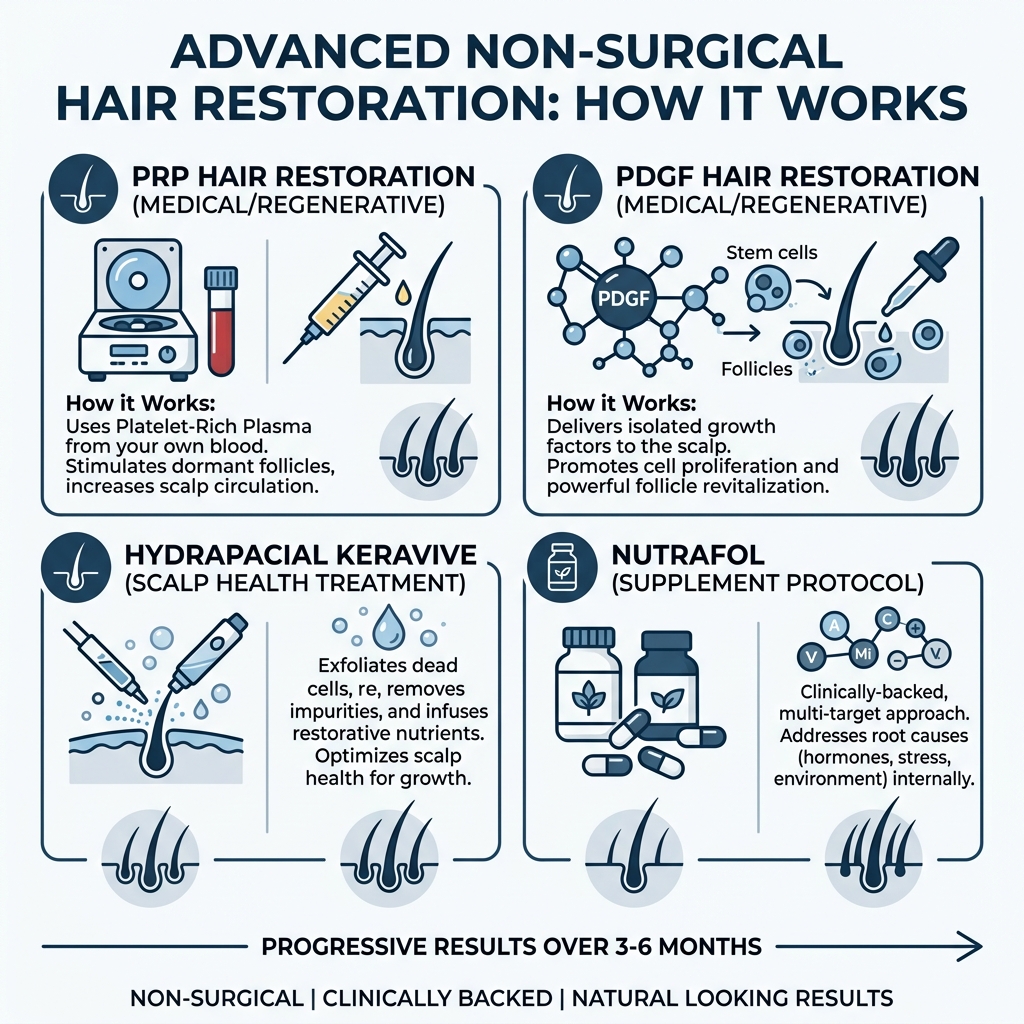
When we talk about non surgical hair replacement systems in a medical context, we are moving beyond “wigs and toupees” and into the realm of regenerative medicine. At our Washington, DC clinic, we utilize the body’s own healing mechanisms to wake up dormant hair follicles.
One of our primary tools is Platelet-Rich Plasma (PRP) therapy. This involves taking a small sample of your blood, concentrating the platelets, and injecting them back into the scalp. These platelets are packed with growth factors that signal follicles to enter the active growth phase. For those looking for even more potency, we offer Platelet-Derived Growth Factor (PDGF) treatments. PDGF is a more refined, highly concentrated version of these growth signals, often providing a more robust response for stubborn thinning.
However, growth factors need a healthy “soil” to grow in. That’s where HydraFacial Keravive comes in. It’s a unique treatment designed to deep-clean the scalp and infuse it with growth factors and skin proteins. To round out the approach, we often recommend Nutrafol supplements. These aren’t your average drugstore vitamins; they are “nutraceuticals” that target the internal triggers of hair loss like stress and hormones.
A 2022 review on PRP efficacy confirmed that these treatments can significantly stimulate new hair growth and increase hair thickness.
| Feature | Medical Non-Surgical (ProMD) | Surgical Hair Transplant |
|---|---|---|
| Invasiveness | Non-invasive injections/topicals | Surgical excision and grafting |
| Recovery | Zero to 24 hours | 7–14 days of visible healing |
| Cost | More affordable per session | High upfront cost ($3k–$15k) |
| Natural Look | 100% your own growing hair | Depends on graft placement |
Personalized Non-Surgical Hair Restoration Plans for Men and Women
Hair loss isn’t a “one size fits all” problem. Men often deal with the classic “M” shape receding hairline or a thinning crown caused by DHT—a hormone that shrinks follicles. Women, on the other hand, frequently experience “diffuse thinning,” where the part line widens and the overall volume of the hair decreases.
At ProMD Health, we don’t just hand you a brochure. We perform a comprehensive scalp health assessment. Whether you are dealing with early-stage thinning or more advanced alopecia areata, our team—including experts like Steele Bolton, RN, and Perla Saliba, FNP-C—customizes a protocol just for you. We might combine PRP with Keravive to ensure your scalp is primed for maximum follicle stimulation.
The Advantages of Medical Non-Surgical Hair Restoration
The biggest “win” with these medical non surgical hair replacement systems is the lack of downtime. Most of our DC patients come in during a lunch break and head right back to K Street without anyone knowing they had a procedure.
Because we are stimulating your natural growth, the results look… well, natural. There are no tell-tale “plugs” or artificial-looking hairlines. You are simply restoring the density you once had. For more details on our specific techniques, check out more info about hair restoration services at ProMD Health DC.
The Science Behind ProMD Health DC’s Hair Restoration Treatments
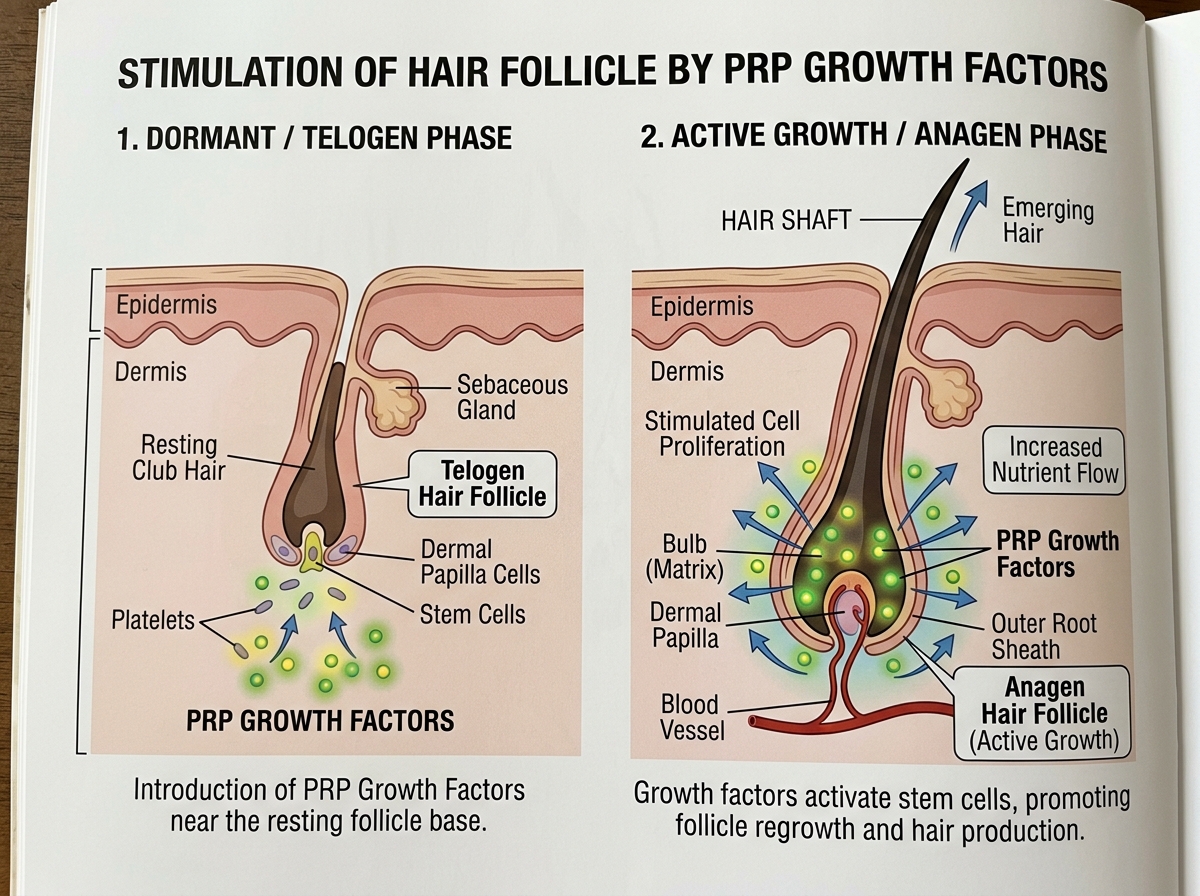
To understand why our treatments work, you have to look at the biology of a hair follicle. Every hair on your head goes through a cycle: growth (anagen), transition (catagen), and rest (telogen). Hair loss occurs when the growth phase gets shorter and the follicles start to shrink—a process called miniaturization.
PRP and PDGF therapy act like a “reset button” for these shrinking follicles. By delivering a concentrated dose of growth factors directly to the root, we can prolong the growth phase and even push resting follicles back into the active phase. A 2020 review found that PRP can significantly increase hair density by improving the blood flow and nutrient delivery to the scalp.
HydraFacial Keravive supports this by removing the “gunk”—dead skin, oil, and product buildup—that can clog follicles and inhibit growth. It creates the optimal environment for our medical treatments to succeed. When you add Nutrafol to the mix, you’re supporting the follicle from the inside out, managing the cortisol and oxidative stress that often lead to shedding.
Maximizing Your Hair Restoration Results: Post-Treatment Care and Lifestyle
Getting the treatment is only half the battle; how you treat your scalp afterward matters. For non surgical hair replacement systems like PRP and PDGF, we recommend a few simple steps to ensure the best outcome:
- Avoid Harsh Chemicals: Skip the heavy dyes or chemical straighteners for at least 48 hours after an injection session.
- Scalp Massage: Gently massaging the scalp can help maintain blood flow to the area.
- Consistency is Key: Medical hair restoration isn’t a “one and done” deal. Most patients need a series of 3 to 4 treatments spaced about a month apart to see the best results.
- Internal Support: Stick to your Nutrafol regimen. It provides the building blocks (like biotin and marine collagen) your hair needs to actually build the new strands we’re stimulating.
We also suggest using the Entity Med AI Simulator during your consultation. It’s our secret weapon for previewing personalized treatment results, helping you visualize what your hair density could look like after your protocol is complete.
ProMD Health DC’s Advanced Non-Surgical Hair Restoration Solutions
Our clinic at 1003 K Street NW is equipped with the latest technology in regenerative aesthetics. We take pride in offering a high-end, comfortable experience where your privacy and results are the top priority.
- PRP Hair Restoration: Our most popular option for those noticing early thinning. It’s a natural way to use your own biology to fight back against aging.
- PDGF Therapy: A “next-level” treatment for those who want the most advanced growth factor technology available today.
- HydraFacial Keravive: Think of this as a “facial for your scalp.” It’s incredibly relaxing and vital for anyone using topical hair growth products.
- Nutrafol: We offer professional-grade Nutrafol to ensure you are getting the correct dosage for your specific type of hair loss (Men, Women, or Post-Menopausal).
As mentioned in a 2023 clinical trial, these types of regenerative treatments are even showing promise for conditions like telogen effluvium (stress-induced shedding), making them a versatile tool in our kit.
Our team, including Jennifer Nicholson, Blair Townsend, and Elvia Cancel, is here to guide you through every step, from the first blood draw to the final follow-up. For a deeper dive, see more info about hair restoration services at ProMD Health DC.
Frequently Asked Questions about Non-Surgical Hair Restoration
How long do the results of PRP/PDGF hair restoration last?
While these treatments stimulate real hair growth, they don’t stop the underlying aging process or genetic predisposition to hair loss. Most patients enjoy their results for 12 to 18 months before a “maintenance” session is needed to keep the follicles active.
What is the typical downtime after PRP/PDGF hair restoration treatments?
Downtime is virtually non-existent. You might experience some mild soreness or “fullness” in the scalp for a few hours, but you can wash your hair the next morning and resume all normal activities, including exercise, within 24 hours.
What is the typical cost of non-surgical hair restoration treatments at ProMD Health DC?
The cost varies based on the specific treatment and the number of sessions required. Generally, a single session of PRP or PDGF is significantly more affordable than the thousands of dollars required for a surgical transplant. During your consultation, we provide a transparent, line-item quote for your personalized plan.
Conclusion
The psychological impact of hair loss can be profound, but you don’t have to accept it as inevitable. Modern non surgical hair replacement systems—specifically the medical regenerative treatments we offer—provide a way to reclaim your confidence without the risks of surgery.
By combining the latest in growth factor science with a holistic approach to scalp health, we help our patients in Washington DC, Montgomery County, and Prince George’s County look and feel like their authentic selves again.
Ready to see what’s possible? Visit us at 1003 K Street NW, Suite 835, Washington, DC 20001, or schedule your consultation today. For more resources, check out more info about hair restoration services at ProMD Health DC.
