

Why More People Are Choosing Non Surgical Hair Treatment
Non surgical hair treatment is a real, evidence-backed way to slow hair loss, thicken thinning hair, and restore scalp coverage — no scalpel, no downtime, no stitches required.
Here are the most effective non-surgical options available today:
| Treatment | How It Works | Best For |
|---|---|---|
| PRP (Platelet-Rich Plasma) | Injects growth factors from your own blood into the scalp | Androgenetic alopecia, early-to-moderate thinning |
| PDGF Therapy | Uses platelet-derived growth factors to stimulate follicles | Diffuse thinning, follicle repair |
| Microneedling | Creates micro-channels in the scalp to trigger healing and growth | Boosting absorption of topicals, improving density |
| HydraFacial Keravive | Cleanses, hydrates, and nourishes the scalp | Scalp health, fine or thinning hair |
| Nutrafol (oral supplement) | Targets root causes of hair loss from within | Hormonal, stress-related, or nutritional hair loss |
| Minoxidil / Finasteride | Medications that extend hair growth phase or block DHT | Male and female pattern baldness |
| Low-Level Laser Therapy (LLLT) | Uses red light to stimulate dormant follicles | General thinning, maintenance |
Hair loss is far more common than most people realize. More than 85% of men and 55% of women will experience some degree of hair loss during their lifetime. For many, it starts subtly — a wider part, a thinner ponytail, a hairline that seems to be shifting back. By the time it becomes noticeable, it can feel overwhelming.
The good news? You don’t have to choose between doing nothing and going under the knife.
Non-surgical treatments have advanced significantly in recent years. Options like PRP therapy, microneedling, and scalp-focused regenerative treatments are now clinically supported and widely available — including right here in Washington, DC at ProMD Health. These treatments work best when hair follicles are still active, which is exactly why starting early matters.
Whether you’re noticing early thinning or dealing with more significant hair loss, understanding your options is the first step.
Easy non surgical hair treatment word list:
Non-Surgical Hair Restoration vs. Surgical Transplants
When we talk about restoring hair, many people immediately picture a surgical hair transplant. While surgery has its place, it’s a major commitment that isn’t right for everyone. Understanding the differences helps us choose the path that fits our lifestyle and goals.
| Feature | Non-Surgical Restoration | Surgical Hair Transplant (FUE/FUT) |
|---|---|---|
| Invasiveness | Non-invasive to minimally invasive | Surgical procedure involving incisions |
| Downtime | Zero to minimal (return to work same day) | 7–14 days for initial healing |
| Scarring | None | Potential linear scar (FUT) or dot scars (FUE) |
| Initial Cost | More affordable per session | High upfront cost ($5,000–$15,000+) |
| Maintenance | Requires periodic follow-up sessions | One-time surgery, but may need meds to keep non-transplanted hair |
| Best Candidate | Early to moderate thinning | Significant balding with stable donor hair |
One of the biggest hair restoration misconceptions is that surgery is “one and done.” In reality, even after a transplant, patients often need non-surgical maintenance to prevent the rest of their natural hair from falling out.
At ProMD Health Washington, DC, we focus on natural-looking results. Surgery moves hair from one place to another, but it doesn’t actually stop the biological process of thinning. Non surgical hair treatment aims to revitalize the follicles you already have, improving hair density and health without the “doll hair” look or the tell-tale scars of a surgical procedure.
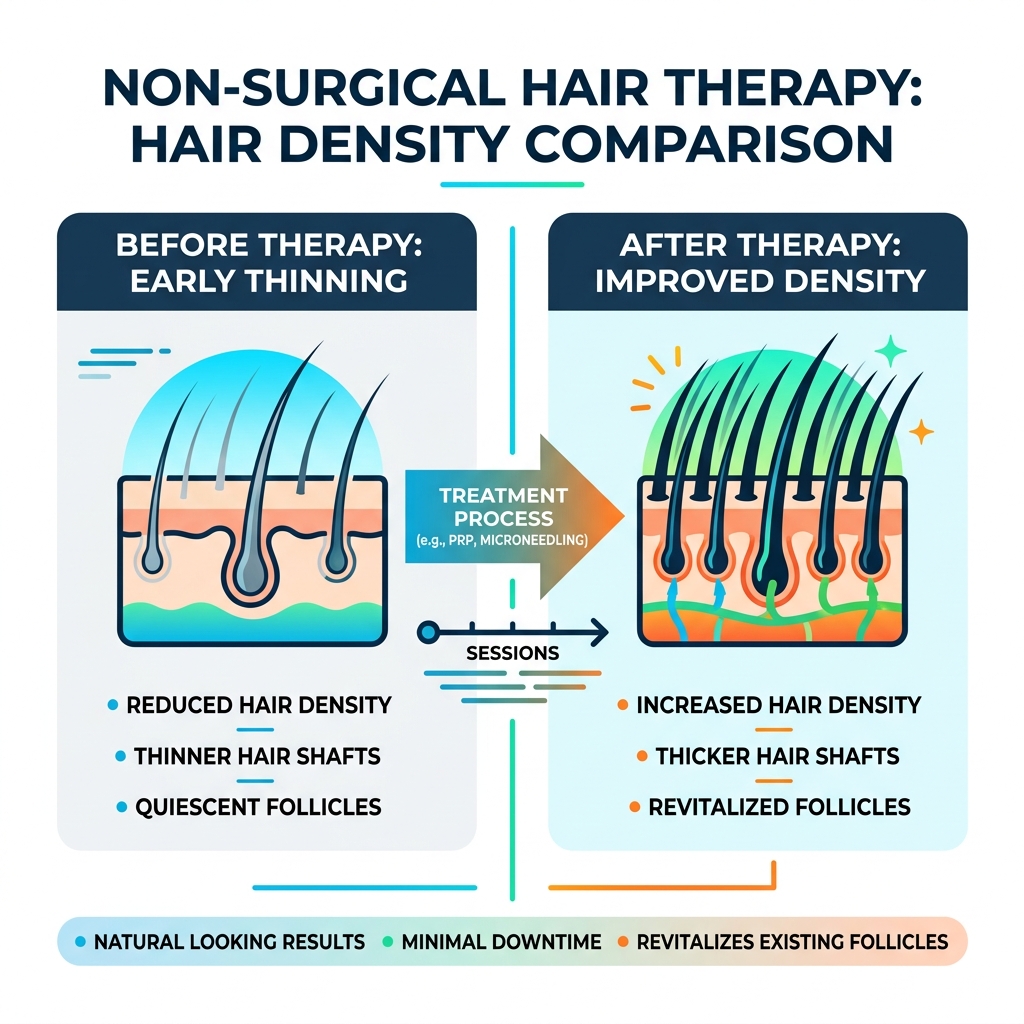
Top Options for Non Surgical Hair Treatment
If you’re looking to avoid the operating room, we have several powerful tools in our kit. These treatments focus on two main goals: stimulating the follicle and improving the environment in which that follicle grows.
Regenerative Medicine: PRP and PDGF Non Surgical Hair Treatment
This is where the science gets really exciting. Regenerative medicine uses your body’s own biological “repair kit” to jumpstart hair growth.
PRP (Platelet-Rich Plasma) Therapy PRP is an autologous therapy, meaning it comes entirely from you. We draw a small amount of your blood and place it in a centrifuge. This machine spins the blood at high speeds to separate the plasma, which is incredibly rich in platelets. These platelets contain hundreds of specialized proteins called growth factors.
When we inject this concentrated plasma back into the scalp, it acts like “fertilizer” for your hair. It increases blood supply to the follicle and triggers the transition of hair from the resting phase (Telogen) back into the active growth phase (Anagen). Scientific research on PRP efficacy shows a high success rate in treating androgenetic alopecia, with many patients seeing a significant increase in hair count and thickness.
PDGF (Platelet-Derived Growth Factor) Therapy PDGF is a more targeted version of regenerative medicine. While PRP contains a broad spectrum of factors, PDGF focuses specifically on the signals that tell cells to divide and blood vessels to form. This is particularly effective for diffuse thinning, where the goal is to repair and strengthen existing follicles that have begun to miniaturize. You can find more info about hair restoration services on our dedicated service page.
Microneedling We often combine these injections with microneedling. Using a specialized device, we create thousands of microscopic “channels” in the skin. This does two things:
- It triggers a natural healing response that boosts collagen and blood flow.
- It allows for much deeper absorption of growth factors or topical treatments.
Advanced Technology: HydraFacial Keravive Non Surgical Hair Treatment
We often forget that the scalp is just an extension of our skin. If the “soil” (your scalp) is clogged, dry, or inflamed, the “plant” (your hair) cannot grow effectively.
HydraFacial Keravive is a unique non surgical hair treatment designed specifically for scalp health. It’s a three-step process:
- Cleanse & Exfoliate: It removes dirt, oil, and dead skin cells that clog follicles.
- Hydrate & Nourish: It delivers a proprietary blend of skin proteins and growth factors.
- Extend & Enhance: A take-home spray helps maintain the results between office visits.
A healthy scalp is the foundation of hair restoration. For those with thinning hair or a dry, itchy scalp, this treatment can significantly improve hair fullness. Check out more info about facial and scalp health to see how we treat the skin from the forehead up.
Clinical Solutions: Nutrafol
While in-office treatments are powerful, we also need to address what’s happening inside your body. Hair loss is rarely caused by just one thing; it’s usually a combination of genetics, stress, hormones, and nutrition.
At ProMD Health, we recommend Nutrafol. Unlike generic drugstore vitamins, Nutrafol is a “nutraceutical” backed by clinical studies. It uses medical-grade botanicals to target the root causes of thinning, such as:
- Cortisol: The stress hormone that can signal hair to enter the shedding phase prematurely.
- DHT: The hormone responsible for shrinking follicles in pattern baldness.
- Micro-inflammation: Which can damage the follicle’s ability to produce healthy hair.
Integrating a high-quality supplement ensures that while we are stimulating the scalp from the outside, your body has the raw materials it needs to build strong hair from the inside. You can find more info about skincare supplements and how they support your overall aesthetic journey on our site.
Frequently Asked Questions about Non-Surgical Hair Restoration
Who is a good candidate for non-surgical hair restoration?
The best candidates are men and women experiencing early-to-moderate hair thinning or “miniaturization” (where the hair strands are becoming finer and shorter). It is also excellent for those with diffuse alopecia or those who want to avoid the risks and downtime of surgery. However, if a follicle has been completely dead for many years and the scalp is shiny and smooth, non-surgical options may be less effective. This is why we encourage a consultation to evaluate your specific hair loss stage.
How long do results from non-surgical treatments last?
Because hair loss is often a progressive biological condition, non surgical hair treatment requires maintenance. Most patients see visible improvement within 3 to 6 months as they move through a full hair growth cycle. To keep those results, we typically recommend “booster” sessions for PRP or PDGF every 6 to 12 months. Think of it like a gym membership for your hair—consistency is key!
Can non-surgical treatments be combined for better results?
Absolutely! In fact, we recommend it. We often see a synergistic effect when combining treatments. For example, using PRP to stimulate the follicles, HydraFacial Keravive to clean the scalp, and Nutrafol to manage internal hormones creates a “360-degree” approach that offers much better results than any single treatment alone.
Conclusion
Restoring your hair doesn’t have to be a scary or invasive process. With modern non surgical hair treatment options, you can take control of your appearance and boost your confidence without ever stepping into an operating room.
At ProMD Health Washington, DC, our team—including Steele Bolton, RN, and Perla Saliba, FNP-C—is dedicated to creating personalized plans that work for your specific type of hair loss. We even offer the Entity Med AI Simulator, so you can get a better idea of what your personalized results might look like before we even begin.
Stop watching your hair thin in the mirror and start your restoration journey today. Our office is conveniently located at 1003 K Street NW in the heart of DC, ready to help you look and feel your best.
Ready to see what’s possible? Schedule a consultation for hair restoration with us today and let’s get your hair back on track.
