

Is Hair Replacement Therapy Right for You?
Hair replacement therapy is a broad term for treatments that restore lost or thinning hair — either through surgery (like transplants) or non-surgical methods (like PRP, PDGF, and scalp treatments).
Here’s a quick breakdown of the main options:
| Type | Method | Downtime | Best For |
|---|---|---|---|
| Surgical transplant | Moves follicles from donor area | 1-2 weeks | Significant baldness |
| PRP therapy | Injects growth factors into scalp | Minimal | Early to moderate thinning |
| PDGF therapy | Uses platelet-derived growth factors | Minimal | Stimulating dormant follicles |
| Topical/oral meds | Minoxidil, finasteride, etc. | None | Slowing loss, early stages |
| Scalp treatments | HydraFacial Keravive, microneedling | Minimal | Scalp health and thickness |
Hair loss is more common than most people realize. At least 70% of men will experience some degree of hair loss in their lifetime, and roughly two out of three men notice it before they turn 60.
But here’s what often goes unspoken: it’s not just a physical change. For many men, thinning hair quietly chips away at confidence — in the boardroom, in social settings, and in the mirror every morning.
The good news? The field of hair restoration has come a long way. You no longer have to choose between doing nothing and undergoing major surgery. Non-surgical hair replacement therapy has become a legitimate, effective option — and it’s more accessible than ever for busy professionals who can’t afford weeks of downtime.
At ProMD Health Washington, DC, we offer science-backed, minimally invasive approaches to hair restoration — including PRP, PDGF, and complementary scalp health treatments — tailored to where you are in your hair loss journey.
This guide covers everything you need to know: what causes hair loss, how modern replacement therapies work, what results look like, and how to figure out which path makes sense for you.
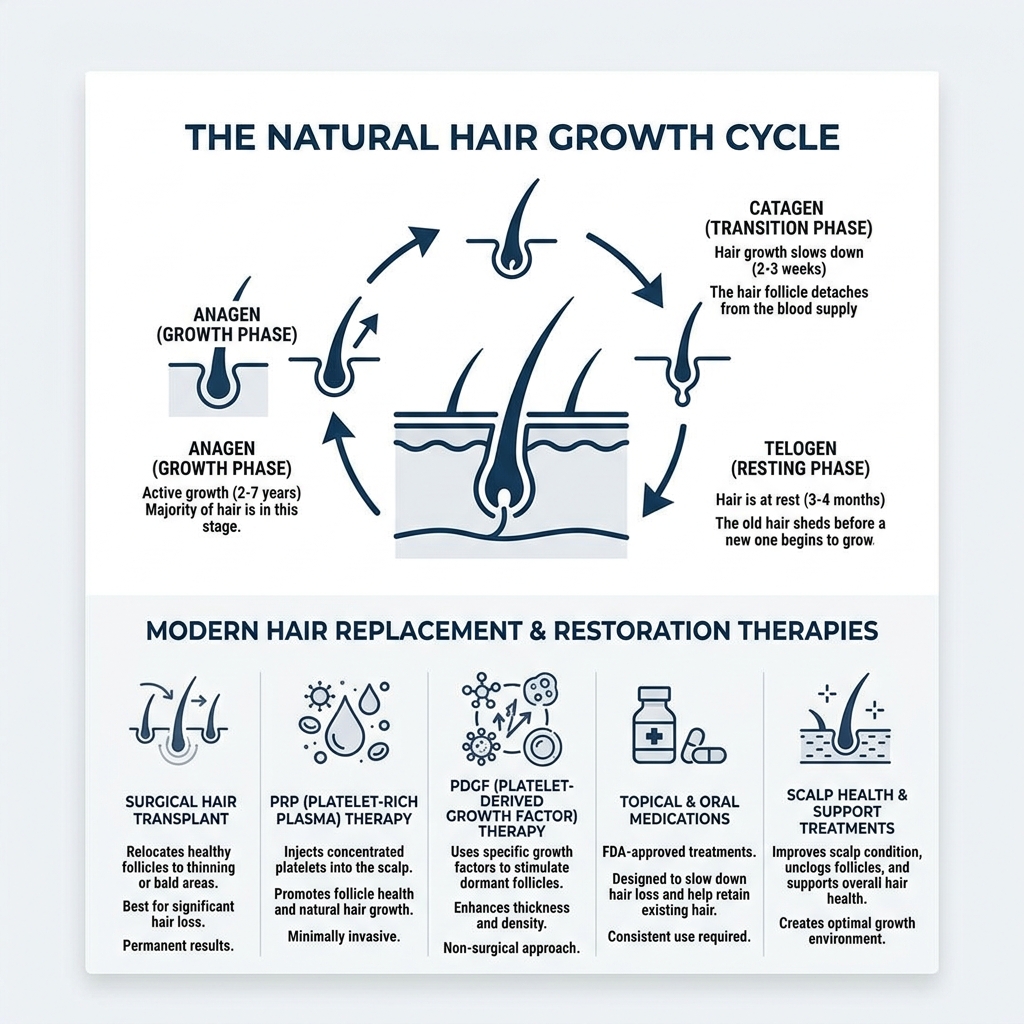
Basic hair replacement therapy terms:
Understanding Hair Loss and the Science of Balding
To understand how hair replacement therapy works, we first have to look at why hair leaves us in the first place. For the vast majority of men, the culprit is Androgenetic Alopecia, commonly known as male pattern baldness.
This condition isn’t about hair “falling out” all at once; it’s about a process called miniaturization. Your hair follicles, which were once producing thick, healthy strands, begin to shrink under the influence of a hormone called Dihydrotestosterone (DHT). DHT is a byproduct of testosterone, and while it’s essential for male development, some of us have hair follicles that are genetically sensitive to it. Over time, the growth phase (anagen) shortens, and the resting phase (telogen) lengthens until the follicle produces hair so thin it’s invisible to the naked eye—or stops producing it altogether.
According to scientific research on hair restoration, the human scalp contains approximately 100,000 to 150,000 hair follicles. At any given time, about 90% to 95% of these should be in the growing phase. When that percentage drops, you start noticing the early signs of hair loss:
- A receding hairline that forms an “M” shape.
- Thinning at the crown (the “monk’s patch”).
- Excessive shedding (more than the normal 50–100 hairs per day).
- Hair that feels “wispy” or difficult to style.
Recognizing these signs early is critical because most hair replacement therapy options—especially non-surgical ones—work best when the follicles are dormant rather than completely gone. You can find more info about hair restoration services to see which stage of loss you might be in.
Advanced Non-Surgical Hair Restoration at ProMD Health DC
For a long time, the only “real” solution for a balding head was a surgical transplant. While modern FUE (Follicular Unit Extraction) techniques have made surgery much better, many of our patients in Washington, DC, are looking for something less intensive.
Our non-surgical hair replacement therapy options are designed to be minimally invasive with virtually no downtime. These treatments don’t involve scalpels or stitches; instead, they use your body’s own biological tools to “wake up” tired follicles.
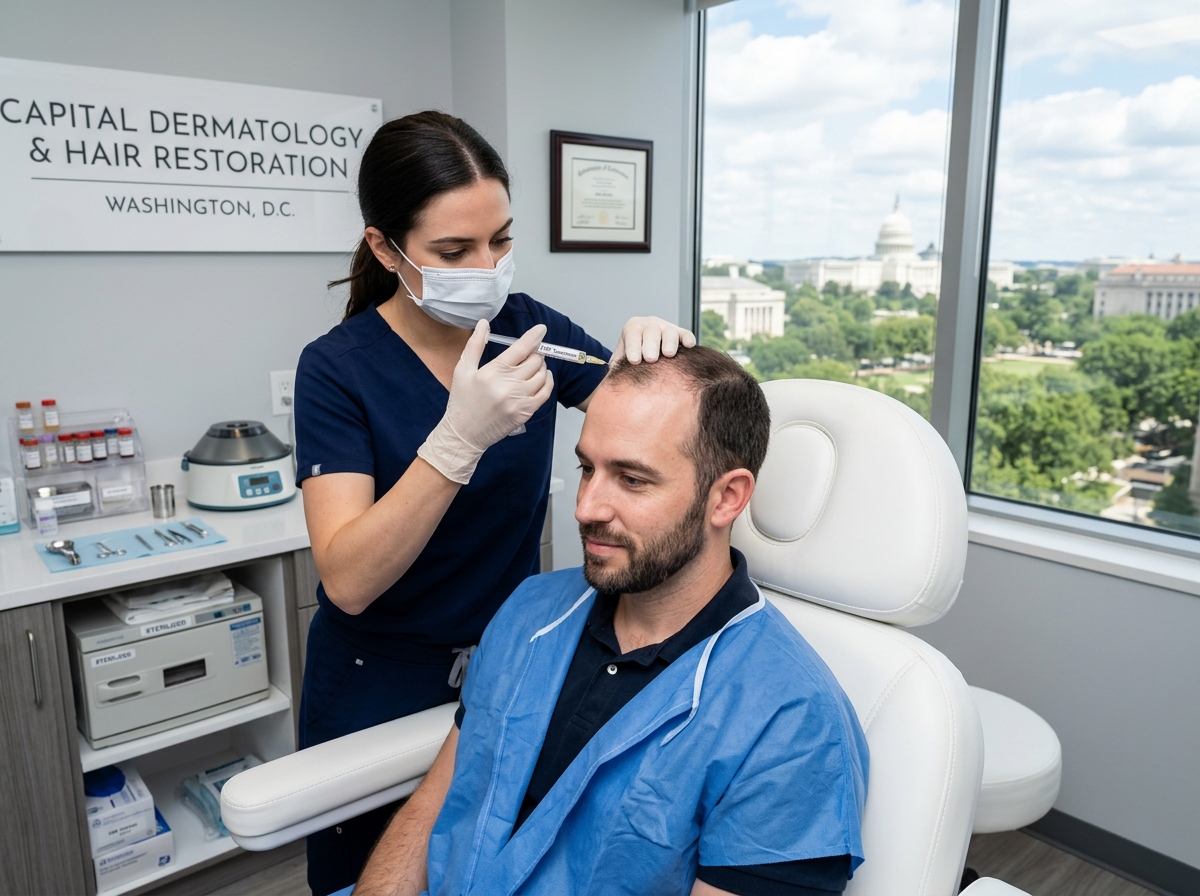
Platelet-Rich Plasma (PRP) for Hair Growth
PRP has become a cornerstone of modern aesthetic medicine. The process is simple: we take a small sample of your blood, spin it in a centrifuge to concentrate the platelets, and then inject that “liquid gold” back into the areas of your scalp where hair is thinning.
Platelets are packed with growth factors like VEGF (Vascular Endothelial Growth Factor) and PDGF (Platelet-Derived Growth Factor). When these are concentrated and delivered directly to the follicle, they help increase blood flow and provide the “building blocks” needed to kickstart the anagen growth phase. This is often paired with other skin-rejuvenating techniques; you can find more info about microneedling with PRP which helps the growth factors penetrate deeper into the scalp tissue.
PDGF Hair Restoration: Harnessing Growth Factors
While PRP is excellent, we also offer specialized PDGF Hair Restoration. PDGF, or Platelet-Derived Growth Factor, is one of the most potent signaling proteins for tissue repair and cell growth.
By focusing specifically on these purified growth factors, we can target the dermal papilla cells—the “command center” of the hair follicle. The mechanism of action involves signaling these cells to proliferate and increase the diameter of the hair shaft. For men, this means hair that doesn’t just grow back, but grows back thicker and more resilient. Check out more info about PDGF Hair Restoration to see how this targeted approach differs from standard PRP.
The Role of Hormone Balance in Hair Health
We cannot talk about hair replacement therapy without addressing the internal environment. Since DHT is the primary driver of male pattern baldness, checking your hormone levels is a vital step.
At ProMD Health, we look at the big picture. If your testosterone levels are imbalanced, it could be accelerating your hair loss. We offer more info about hormone therapy because restoring a healthy hormonal baseline can often slow down the rate of loss, making your topical and injectable treatments much more effective.
Complementary Treatments and Maintenance for Hair Health
Think of your scalp like a garden. Injectable treatments like PRP and PDGF are the “fertilizer,” but you still need to pull the weeds and maintain the soil. We often recommend a multi-pronged approach to ensure the longevity of your results.
- Nutrafol: This isn’t your average drugstore vitamin. It’s a medical-grade nutraceutical designed specifically to target the root causes of thinning, including stress and hormones.
- HydraFacial Keravive: This is a unique treatment that cleanses, exfoliates, and hydrates the scalp. It removes impurities and clogged follicles that can hinder hair growth.
- Microneedling: Creating tiny micro-channels in the scalp triggers a natural healing response and allows for better absorption of any topical treatments you might be using at home.
Recovery, Results, and Realistic Expectations
One of the biggest questions we get is: “How soon will I see hair?”
It is important to remember that hair grows in cycles. While a surgical transplant might show 60% of new growth after 6-9 months, non-surgical hair replacement therapy follows a similar biological timeline.
- Months 1-3: You may notice a decrease in shedding. This is a sign that the follicles are stabilizing.
- Months 3-6: You might see “baby hairs” or increased fuzz in previously thin areas.
- Months 6-12: This is when the real “wow” factor happens. The hair shafts become thicker, and the overall density of the scalp improves.
Post-treatment care is simple: avoid harsh chemicals or intense exercise for about 24–48 hours after injections. Beyond that, you can return to your normal Washington, DC, routine immediately. For a deeper dive into what to expect, read the research on non-surgical hair restoration outcomes.
Frequently Asked Questions about Non-Surgical Hair Restoration
What is the cost of non-surgical hair restoration?
The cost varies depending on the number of sessions required and whether you choose PRP, PDGF, or a combination of treatments. Generally, non-surgical options range from $1,500 to $4,000 for a full treatment cycle. While this is an investment, it is often significantly less expensive than the $4,000–$15,000 price tag associated with surgical transplants.
Are the results of non-surgical hair restoration permanent?
Because androgenetic alopecia is a progressive genetic condition, no treatment is truly “one and done.” Think of it like going to the gym; you need maintenance to keep the results. Most men find that an annual or semi-annual maintenance session keeps their hair looking full and healthy.
Who is an ideal candidate for non-surgical hair restoration?
The ideal candidate is someone in the early to moderate stages of hair thinning. If you still have visible hair but notice your scalp is becoming more prominent, you are likely a great candidate. If an area is completely “shiny” and bald, the follicles may have scarred over, in which case surgery might be the only option.
Conclusion
Losing your hair doesn’t have to be an inevitable part of aging. Whether you’re just starting to notice a receding hairline or you’ve been thinning for years, there is a hair replacement therapy that can help you reclaim your look.
At ProMD Health Washington, DC, we believe in using the best technology available. This includes our Entity Med AI Simulator, which allows you to see a personalized preview of your potential results before you even start treatment. It takes the guesswork out of the process and helps us build a plan that fits your goals.
Ready to see what’s possible? We invite you to schedule a personalized consultation at our K Street office. Our team, including experts like Steele Bolton, RN, and Perla Saliba, FNP-C, is here to guide you through every step of the journey.
